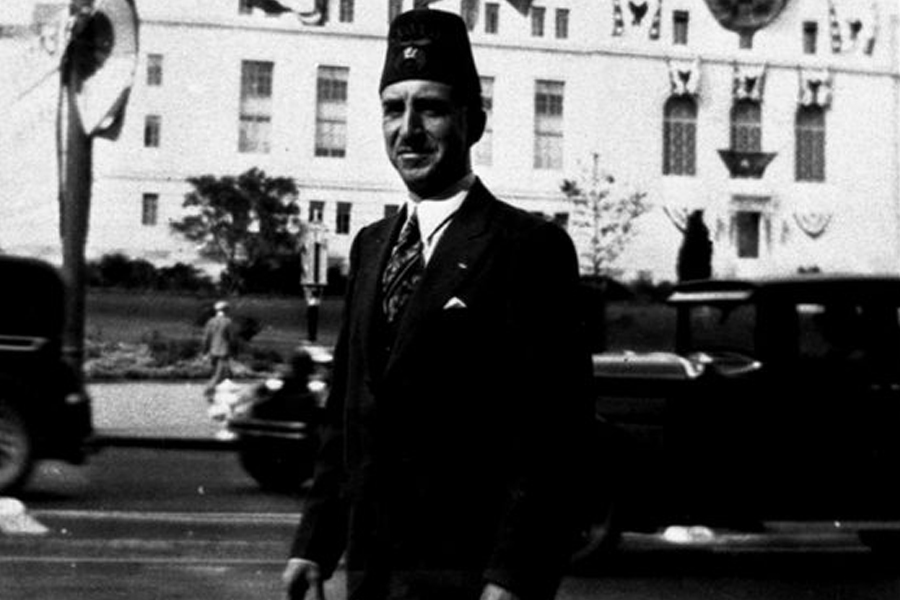
Early Life in Chicago
Raymond Arnold Disney lived a long, reticent life that rarely sought applause. He was born in Chicago on December 30, 1890, during a brisk American century. By the time he died in 1989, the country had changed beyond recognition. His lifespan reached 98 years, which gave him an unusually broad historical horizon. Still, his own story remained modest, disciplined, and distinctly private. That contrast makes him a fascinating figure within the Disney family.
Raymond’s parents were Elias Charles Disney and Flora Call Disney. They raised a large household rooted in Midwestern practicality. His siblings included Herbert Arthur, Roy Oliver, Walter Elias, and Ruth Flora. Each sibling would follow a different trajectory through American life. That variety makes the family feel less like a myth and more like a living household. Raymond sat within that household as a quiet, observant presence.
Chicago at the century’s edge was noisy, industrial, and migratory. Families like the Disneys carried ambition alongside thrift. That environment likely shaped Raymond’s preference for measured routines. Not every child in such a household becomes a public pioneer. Some learn instead to keep the scaffolding intact. Raymond seems to have occupied that steadier role.
A Family of Divergent Paths
His brothers Roy and Walt became the most publicly celebrated members of the family. Roy helped manage the business side of the entertainment enterprise. Walt became a creative icon whose name spread worldwide. Raymond, by contrast, moved in a more subdued orbit. He did not step into the studio’s public machinery. That separation gave him a different kind of dignity.
Family history often magnifies the loudest personalities. Raymond’s life reminds us that other relatives still matter. They hold the domestic structure together. They preserve the quieter textures of memory. He appears less as a headline and more as a stabilizing contour. Such figures often disappear from popular retellings, yet they remain essential.
Raymond’s place in the family also reveals a useful social truth. Fame can cluster around only a few names. The surrounding relatives still build the moral architecture of the household. They witness births, losses, and the ordinary calendar of family life. Raymond’s story suggests patience rather than spectacle. It is an unflashy kind of significance.
Career in Insurance and Local Finance
Raymond worked in insurance and related local business fields. Those professions required patience, calculation, and social trust. They also demanded fluency with ledgers, contracts, and long client relationships. Some accounts connect him with banking earlier in life. Together, those roles place him firmly inside practical commerce. They also separate him from the family entertainment machinery.
Insurance work fit a temperament that valued caution over spectacle. It rewarded reliability, client memory, and careful arithmetic. Those traits are easy to overlook in family legend. Yet they matter in any community that depends on trust. Raymond’s professional life therefore reads as quietly consequential. It was practical labor with durable social utility.
Reportedly, his active business years stretched from the 1920s into the 1960s. That span suggests nearly four decades of professional continuity. He was not a transient worker drifting between occupations. He was a long-range participant in the ordinary economy. Such steadiness can seem unglamorous, yet it often supports entire communities. Raymond’s career belongs to that respectable, unspectacular tradition.
The records describe him as an insurance salesman and business owner. That profile carries the scent of dependable neighborhoods and repeated appointments. It evokes offices with paper files, client visits, and long memory. It also suggests a man comfortable with incremental progress. His work did not require marquee billing. It required steadiness, persuasion, and discretion.
There is no dependable public evidence that he held studio power. That absence is itself revealing, because proximity to legend can still mean distance from control. Raymond lived near a family empire without governing it. He seems to have preferred autonomy over corporate visibility. That choice made his life less conspicuous, but not less substantial. It gave him a place outside the glare.
Marriage and Family Life
Raymond reportedly married Meredith Alvah Boyington in the mid 1930s. Some records also list her as Meredith A. Fisher. That inconsistency is typical in family history research. Marital records can shift when names, places, and later recollections diverge. Still, the available details sketch a settled domestic partnership. It seems to have unfolded outside public scrutiny.
The marriage places Raymond squarely inside the social rhythm of mid century America. The 1930s demanded resilience, thrift, and emotional durability. A private household in that era often depended on habits more than declarations. Raymond’s family life likely reflected those priorities. Such lives are rarely theatrical. They are usually built from obligation, courtesy, and repetition.
Two sons are associated with Raymond in family records. Charles Elias Disney appears as his son. Daniel Harwood Disney is often listed as an adopted son. Those names extend the family line into another generation. They also hint at the ordinary priorities of parenthood. Legacy, in such families, is often measured at the dinner table.
Children bring continuity into lives that otherwise dissolve into dates. They turn private history into living memory. Raymond’s sons carried the surname into a new era. That detail matters because names are one of history’s most durable instruments. Family records preserve these links with quiet persistence. They keep the lineage visible long after public attention moves elsewhere.
Later Years and Public Memory
Raymond’s later life was marked by uncommon longevity. He reached age 98, an achievement few people attain. He died on May 24, 1989, in the Santa Monica area. That date placed his death near the end of a changing century. He had seen Hollywood transform from novelty into empire. He had also seen his younger brothers become historical figures.
He lived long enough to watch entertainment become an industry of immense scale. He also lived long enough to watch family reputation harden into legend. That can be a peculiar experience for any sibling. One generation becomes biography, while another remains memory. Raymond appears to have handled that asymmetry with restraint. His own public posture stayed modest.
Public traces of Raymond are mostly commemorative and genealogical. He appears in family histories, obituaries, and remembrance posts. Those records emphasize continuity rather than controversy. There is little evidence of scandal, feuding, or dramatic corporate entanglement. That absence gives his story a calm, almost archival texture. It is the texture of a life lived near greatness, not inside its spotlight.
Modern interest in Raymond often arises from Disney genealogy rather than business history. Researchers and family enthusiasts seek the names behind the famous surname. That interest is understandable, because families contain unpublicized layers. Raymond’s layer is one of privacy, steadiness, and limited documentation. Even thin records can still suggest a coherent character. He appears measured, cautious, and firmly separate from performance culture.
His longevity also gives historians a rare bridge across eras. He was born before automobiles filled the streets. He died after cable television had altered domestic life. That span makes him more than a footnote. It turns him into a witness to nearly a century of change. Yet his own preferences remained compact and personal.
Key Takeaways
Raymond Arnold Disney offers a useful counterpoint to celebrity driven family narratives. He was born in 1890, worked for decades, and died in 1989. He stayed outside the family entertainment business. He built a private professional life in insurance and banking related work. He also left a family footprint through marriage, children, and longevity. Taken together, those details describe a life of restraint, continuity, and quiet distinction.