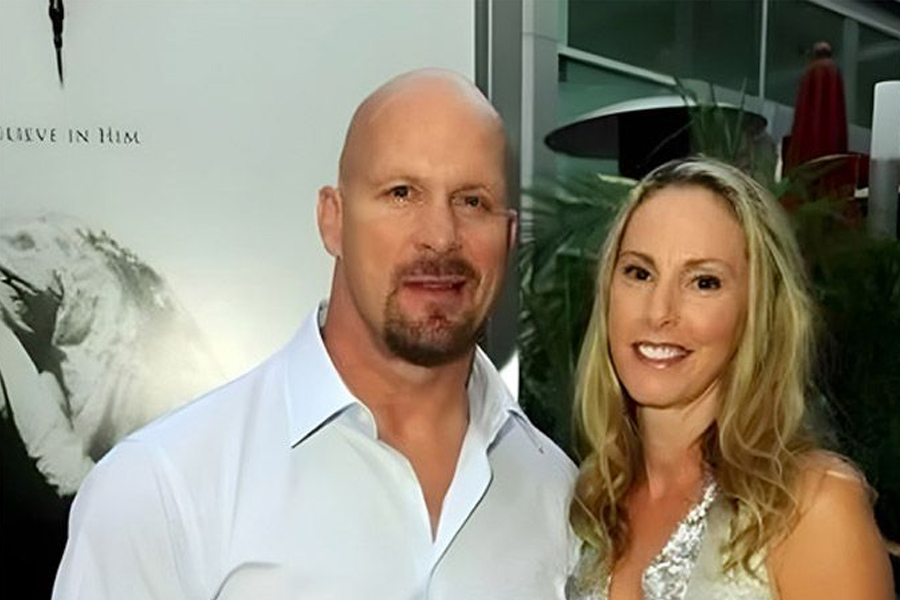
Basic Information
Kathryn Burrhus is chiefly recognized as the first wife of Steve Austin. Her name appears most often inside biographies of Austin, not within a separate public career record. That narrow visibility gives her a peculiar place in celebrity history. She is known, but only within a limited factual perimeter. The verified details are sparse, yet they are stable. She married Steve Austin on 24 November 1990. Their marriage ended by annulment on 7 August 1992. No documented children are publicly tied to that union.
A Private Figure Near a Public Storm
Kathryn Burrhus exists in the public imagination as a restrained, almost spectral presence. Her story is not built from interviews, campaigns, or a visible professional arc. Instead, it is assembled from brief references attached to someone else’s fame. That makes her biography unusual in modern celebrity culture. Most people linked to prominent figures accumulate abundant digital residue. Burrhus does not. Her profile remains compact, indirect, and notably resistant to embellishment. The available record stays within a few firm markers, which is rare and telling.
Her connection to Steve Austin matters because it places her at the origin of a famous life narrative. Austin’s later renown would become immense, spanning wrestling, media, and public legend. Burrhus appears before that expansion fully arrived. She belongs to an earlier chapter, when the future was less theatrical and less documented. This early association gives her a historical role, even without public performance. She is part of the prelude, not the spectacle.
The Marriage Years
The marriage between Kathryn Burrhus and Steve Austin began on 24 November 1990. That date anchors nearly every account of her public identity. It marks a formal union during a formative stage in Austin’s career. The marriage lasted until 7 August 1992, when it was annulled. The interval was brief, yet it occupies a durable place in Austin retrospectives. Two dates define the entire publicly verified relationship. That kind of compression is striking, and it leaves little room for speculation.
The years 1990 through 1992 were significant for Austin professionally. His rise was gathering force, and his public trajectory was beginning to sharpen. Burrhus shared that period, but not the spotlight it eventually produced. Their marriage therefore sits at the intersection of private attachment and public ascent. It is an instructive reminder that famous careers often begin inside ordinary domestic arrangements. Those arrangements can vanish from view even as the fame expands. In Burrhus’s case, the marriage became the main archival trace.
The High School Sweetheart Image
Kathryn Burrhus is often described as a high school sweetheart of Steve Austin. That phrasing gives the relationship a familiar romantic shape. It suggests continuity from adolescence into adulthood, with marriage arriving after years of shared history. The image is evocative, though the surviving public record remains thin. It is more descriptive than documentary. Still, it helps explain why her name persists. People are drawn to origin stories, especially when they involve later celebrities.
The high school sweetheart label also compresses a whole private history into a single social shorthand. It leaves out the texture of daily life, family settings, and personal ambitions. It avoids the burden of detail while preserving emotional resonance. That is often how biography works in the public sphere. The fuller story remains unavailable, and the shorthand becomes the substitute. For Burrhus, that substitute has endured for decades. It is concise, plausible, and incomplete.
What Is Documented
The public record around Kathryn Burrhus is notably restrained. Her occupation is not publicly documented in reliable terms. Her date of birth is not firmly established in mainstream public records. Her place of birth is also not reliably documented. There is no verified public biography that outlines a career arc or media presence. No authoritative social media presence is widely confirmed. No principal media work is attached to her name with confidence.
That scarcity matters because it limits interpretive excess. It prevents the easy manufacture of a dramatic backstory. It also protects the boundary between historical fact and rumor. In an internet era that rewards repetition, repeated absence can be meaningful. Burrhus is not a blank slate, but she is close to one in public terms. The record supports only a few conclusions. She was married to Austin. The marriage ended in 1992. Beyond that, the confirmed trail becomes faint.
| Category | Verified Public Detail |
|---|---|
| Full name | Kathryn Burrhus |
| Best known for | First wife of Steve Austin |
| Marriage date | 24 November 1990 |
| Marriage end | 7 August 1992 |
| Children with Austin | None documented |
| Occupation | Not publicly documented |
| Birth date | Not publicly documented |
| Birthplace | Not publicly documented |
Family and Relationship Boundaries
Family details beyond the marriage are not securely documented. Parents and siblings are not broadly identified in major public outlets. Extended family information is similarly limited. This absence is not merely an omission. It is part of the profile itself. Some people attached to famous figures become visible through relatives, interviews, and public appearances. Burrhus has not followed that pattern. Her footprint remains deliberately small.
That limited visibility also distinguishes her from later spouses and public companions in Austin’s life. Those later chapters are more widely narrated and more densely circulated. Burrhus occupies the first and least elaborated chapter. She is the spouse with the briefest public contour. Yet brevity should not be mistaken for insignificance. In biographical structure, first positions often carry symbolic weight. They mark the opening frame of a later, much larger story.
Why Her Story Stays Sparse
Kathryn Burrhus illustrates how private lives can persist inside public memory without becoming public property. Her name survives because of an association, not because of a cultivated persona. That is an unusually narrow basis for enduring visibility. It produces a record that is factual, but austere. There are no sprawling claims to reconcile, and no elaborate mythology to unravel. The silence is cleaner than the speculation.
This scarcity also protects against false precision. It is tempting to pad such biographies with guessed occupations, estimated finances, or invented family details. That would weaken the truth. Burrhus’s story does not need ornamentation. It needs accuracy, restraint, and proportion. Those qualities are difficult to maintain in celebrity writing, where abundance often masquerades as knowledge. Here, the smaller account is the better one.
Timeline of Known Facts
| Date or Period | Event |
|---|---|
| Pre 1990 | Described as Steve Austin’s high school girlfriend |
| 24 November 1990 | Married Steve Austin |
| 1991 to 1992 | Austin’s career advanced while the marriage moved toward its end |
| 7 August 1992 | Marriage annulled |
| Post 1992 | Remained largely outside public view |
The timeline is short, but it is coherent. Each entry is anchored by a stable fact rather than a rumor. The chronology also reveals how little public information survived after the marriage ended. That absence has become part of her identity in print. Many biographies grow by accretion. Burrhus’s does not. It remains compact across time, almost archivally severe.
Public Memory and Minimalist Biography
Public memory has a habit of flattening certain lives into reference points. Burrhus becomes one such point in the larger account of Steve Austin. She appears as the first spouse, the early attachment, the name before the fame hardened. This reduction is not entirely unjust. It reflects how the public record actually behaves. Yet it also reveals the limits of fame’s shadow. Not everyone adjacent to celebrity becomes equally legible.
Kathryn Burrhus therefore occupies a rare biographical category. She is publicly known, but not publicly elaborated. She is named, but not extensively narrated. That distinction gives her story its unusual texture. It is spare without being empty, private without being erased. The documented facts stay simple and durable. They define a life that has remained largely outside the frame.