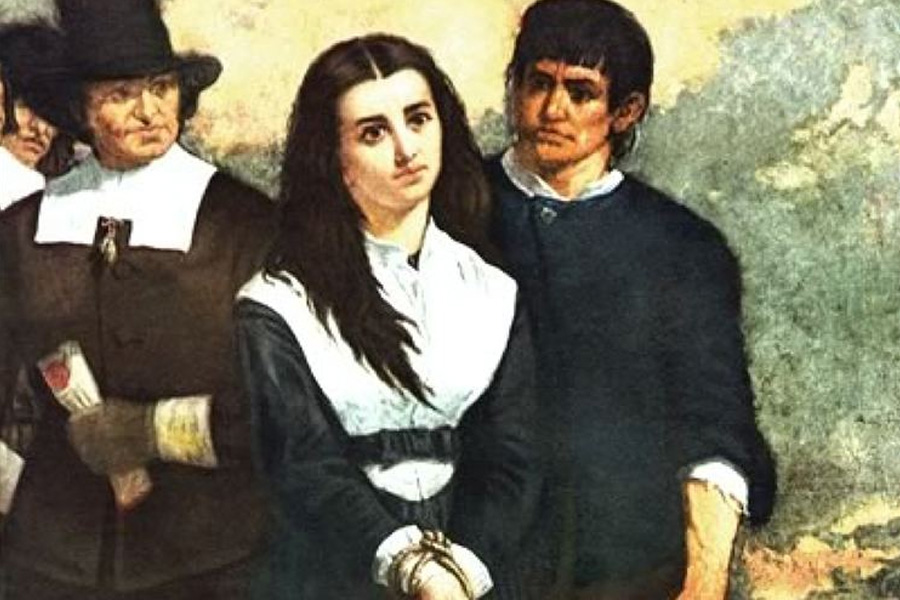
A Life Shaped by Colonial Burden
Mary Eastey lived in a world where household duty, kinship, and danger were tightly interwoven. Born Mary Towne in 1634, she entered a Massachusetts colony still defining its social habits, religious discipline, and legal habits. Her baptism on August 24 in Great Yarmouth, Norfolk, placed her at the edge of two worlds. One world was English, inherited, and distant. The other was colonial, austere, and still being assembled.
She later lived in Topsfield with her husband, Isaac Estey, and their children. Their home stood inside a society that prized sobriety and obedience. That same society could turn swiftly, however, from order into menace. In 1692, Salem made rumor feel like evidence. Ordinary life became precarious, and reputation became a fragile possession.
Mary’s story remains forceful because it resists simplification. She was not only a condemned woman. She was a wife, mother, sister, and daughter embedded in a broad New England family. Her life reveals how public hysteria could invade domestic permanence. It also shows how dignity could persist under intolerable pressure.
The Towne Family Network
Mary was the daughter of William Towne and Joanna Blessing Towne. Their family had crossed the Atlantic in the 1630s, joining the early Massachusetts settlement pattern. They raised eight children, and those children became deeply entangled in the life of their region. The Towne family was large, interlinked, and historically consequential.
Her siblings included Rebecca Nurse, Sarah Cloyce, John Towne, Susannah Towne, Edmund Towne, Jacob Towne, and Joseph Towne. Among them, Rebecca Nurse and Sarah Cloyce became the most prominent in Salem history. Their names recur because the trials did not isolate individuals cleanly. Instead, suspicion moved through family proximity like an electrical charge. One charge could illuminate the next.
Mary’s relationship to Rebecca Nurse matters especially. The two sisters embodied a grim symmetry. Each became a witness to the collapse of communal trust. Each faced an environment where accusation could outweigh character. Sarah Cloyce, another sister, shared that burden in her own manner. Together, the sisters show how persecution can cluster around family lines.
The Towne family tree also reminds readers that Mary lived within a dense social fabric. William Towne and Joanna Blessing Towne were not distant genealogical facts. They were the root system of a household that endured migration, settlement, labor, and eventual scandal. In a narrow village society, family identity was never merely private. It carried civic weight.
Marriage Household and Labor
Mary married Isaac Estey around 1655 or 1656. He worked as a farmer and cooper in Topsfield. Local records suggest he was a man of some standing. Their marriage likely combined practical partnership with the durable obligations expected in colonial life.
Together, they raised a large family. The children most often named are Isaac Jr., Joseph, Sarah, John, Hannah, Benjamin, Samuel, Jacob, and Joshua. That list is not decorative genealogy. It defines the scale of Mary’s daily responsibility. She managed a household shaped by labor, childbirth, food production, and unrelenting maintenance.
Colonial domestic work demanded perseverance and acuity. It required mending, preserving, planning, and enduring. Much of that work remained invisible in public memory. Yet it formed the foundation of survival. Mary’s life was not idle by any measure. Her significance began long before the courtroom.
Her family also extended beyond her immediate children. Later descendants often linked to her line include Moses Estey, Eleanor Griffith, Sarah Cummings, and Benjamin Gill. Family records can differ in naming and arrangement, but the broader lineage remains clear. Mary’s household survived in memory even after injustice severed her life.
Salem and the Collapse of Trust
The Salem witch trials transformed accusation into a social weapon. In that atmosphere, Mary’s respected status did not protect her. Instead, it may have sharpened suspicion. A woman with family connections, regional familiarity, and strong ties could become an especially useful target. Her visibility became vulnerability.
Mary was first arrested and examined on April 21 to 22, 1692. She was later released on May 18 after a short confinement. That reprieve did not last. She was arrested again between May 20 and 23. The pace of events shows how unstable the proceedings had become. Release offered no reliable safety.
The trials operated through fear, repetition, and accusation. They often converted rumor into procedural momentum. Mary’s case demonstrates how quickly a community can normalize coercion. Once suspicion starts circulating, social standing may count for very little. The logic of panic is rarely careful.
Mary’s experience also reveals the gendered nature of the period. Women were expected to be quiet, compliant, and deferential. Mary did not remain silent. Her surviving words show steadiness, grief, and moral force. She refused to let the court define truth unchallenged. That refusal gives her history a stubborn clarity.
The Petitions and Mary’s Voice
Mary’s petitions are among the most powerful surviving documents from the Salem crisis. One was written with Sarah Cloyce and asked for fair hearing and witness testimony. The other, written after sentencing, pleaded that no more innocent blood be shed. These are not theatrical texts. They are compressed acts of moral resistance.
Their power lies in their restraint. Mary did not indulge in ornament. She framed injustice plainly. Her words sound both wounded and lucid. They contain sorrow, but not surrender. In a setting built to silence accused women, her voice still traveled.
Her petitions also reveal how deeply she understood the stakes. She was not pleading only for herself. She was naming a larger failure in judgment. That distinction matters. She transformed personal suffering into public witness. Her language survives because it does more than complain. It indicts.
The emotional register of those petitions is severe but controlled. Mary did not trade in hysteria. She made a case. That alone marks her as unusual in the record. Her testimony remains compelling because it fuses humility with a fierce claim to justice.
A Brief Timeline
| Date | Event |
|---|---|
| 1634 | Mary Towne is baptized in Great Yarmouth, Norfolk |
| 1630s | The Towne family moves to Massachusetts |
| 1655 or 1656 | Mary marries Isaac Estey |
| April 21 to 22, 1692 | Mary is arrested and examined |
| May 18, 1692 | She is released briefly |
| May 20 to 23, 1692 | She is arrested again |
| September 9, 1692 | Mary and Sarah Cloyce submit a petition |
| September 22, 1692 | Mary is executed |
| 1710 | Isaac Estey petitions for compensation |
| 1711 | Reversal of attainder and restitution follow |
This chronology clarifies the compressed horror of her final year. The events unfolded with punishing speed. Arrest, release, renewed arrest, petition, and execution all occurred within months. That sequence underscores the instability of legal process during the trials. It also shows how little time the accused had to defend themselves.
Mary Within the Wider Family Circle
Mary’s family cannot be separated from her public fate. William Towne and Joanna Blessing Towne were the ancestral center. Rebecca Nurse and Sarah Cloyce were the best known sisters. John Towne, Susannah Towne, Edmund Towne, Jacob Towne, and Joseph Towne rounded out the sibling network commonly listed in family histories. Isaac Estey stood beside her as husband and laboring partner.
Her children formed the next ring of that family structure. Isaac Jr., Joseph, Sarah, John, Hannah, Benjamin, Samuel, Jacob, and Joshua all belonged to the household Mary helped sustain. Their lives carried the consequences of her persecution. Family history, in this case, is not abstract. It is a record of disruption and continuation.
Later descendants preserved that memory in extended form. Moses Estey, Eleanor Griffith, Sarah Cummings, and Benjamin Gill appear in the broader lineage. Sarah Estey Gill Ireland is also associated with the family material. Such variations are common in historical family records. They do not weaken the line. They show how memory travels through uneven documentation.
Mary’s family resembles a woven net rather than a tidy branch. Every node touched another. Every relationship mattered. That density made the family resilient, but it also made them exposed. In Salem, kinship could become evidence by association.
Material Loss and Aftermath
Mary’s imprisonment imposed real economic damage. Isaac Estey later sought compensation for her confinement and his own losses. The colony eventually granted restitution after the attainder was reversed. That outcome did not restore Mary’s life. It did, however, confirm that the state had inflicted measurable harm.
Financial records matter because they ground tragedy in practical terms. A family lost labor, time, stability, and earning capacity. Those losses accumulated alongside grief. In a farming and trade household, even brief disruption could ripple widely. Mary’s case therefore belongs not only to legal history, but also to economic history.
The aftermath also matters morally. A later acknowledgment of harm cannot cancel execution. It can only indicate belated recognition. That recognition arrived too late for Mary. Still, it confirms that the surrounding society eventually had to reckon with the damage.
Key Takeaways
Mary Eastey was a baptized English-born Massachusetts woman whose life became entangled in the Salem witch trials of 1692. She lived in Topsfield with Isaac Estey and their large family, and she moved within a powerful Towne kin network that included Rebecca Nurse and Sarah Cloyce.
Her petitions remain central to her legacy because they combine grief, clarity, and direct moral protest. They show a woman demanding justice in a system already leaning toward condemnation.
Her story also reveals how family, labor, gender, and law collided in colonial New England. Mary’s life was not defined only by death. It was defined by endurance, domestic responsibility, and a voice that refused to disappear.